
You’ve decided to join in on the New Year trends. New year, new me, they say. Or maybe you’ve already been looking after your body more and are thinking about what else you can do. First thing — and most importantly — diet and exercise are the long-term changes you need to make. But! The right supplements, taken at the right time of day, will give you that extra percentage when it comes to feeling good and staying on track.
When you make a new change in life — be it diet, exercise, mindfulness, or simply being more self-aware and making a conscious effort — it’s all about routine and consistency. Supplements genuinely help you stay in that routine long-term; they set you up for the day. Usually, it’s the first thing you do (or the first thing I do anyway), and it makes you think about the choices you’ll make for the rest of the day. Then you take your evening or pre-bedtime supplements, which makes you think about getting a good night’s sleep and being prepared for the morning.
Supplements become the start of a positive routine cycle for me. They shift me into health mode mentally. When I was on my first real, consistent diet, I listened to Ethan Suplee’s podcast on weight loss every single morning — not because I enjoyed it (sometimes I didn’t), but because it put my brain into positive-choice mode. Supplements aren’t going to make you superhuman or do the hard work for you, but fuck me, they’re the added 5–30% on the days when you really need them.
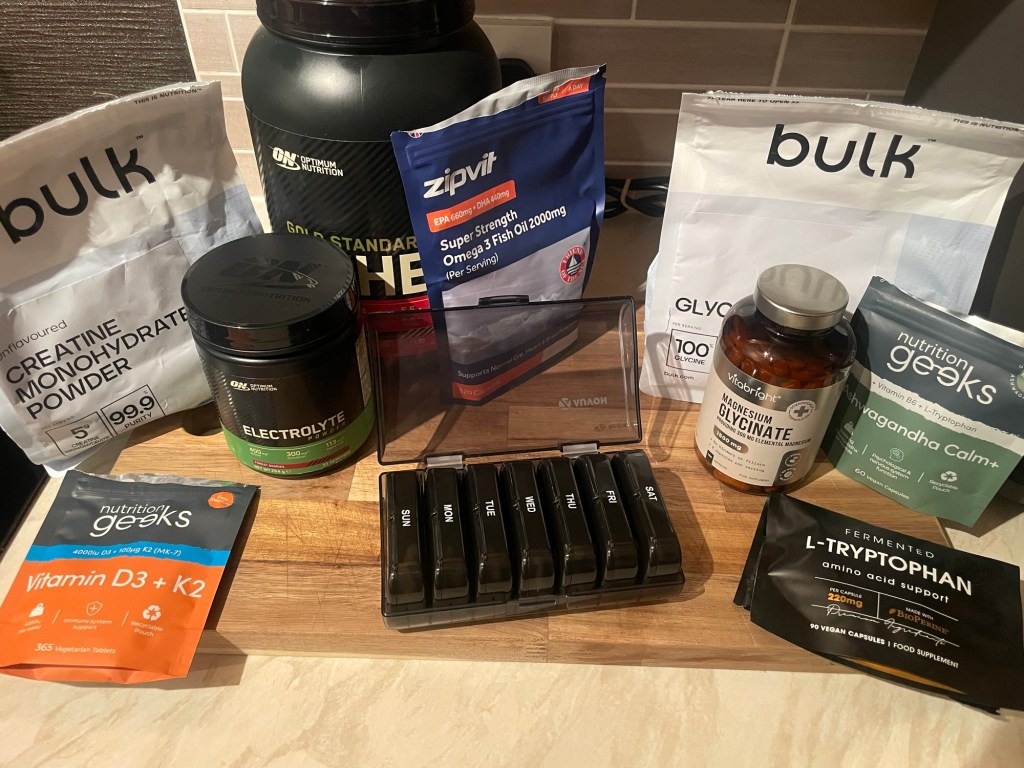
Now, this is my “stack” — everyone will have different ones. Whey protein, as a “supplement”, does come with some caveats and different options. It’s also the most costly, but I treat it as a lightweight protein boost when I’m not fasting.
Morning Supplement Stack:
• Creatine Monohydrate Powder 5g (Bulk £8.99 / £32.81pa)
• Vitamin D3 & K2 4000iu / 100ug (Nutrition Geeks £8.99pa)
• Omega-3 Fish Oil 2000mg (Zipvit £9.97 / £52.82pa)
• Electrolyte Powder (ON £7.79 / £86.16pa)
• Whey Protein (ON Gold £34.00 / £443.21pa)
No whey protein if fasting
Evening Supplement Stack:
• Glycine Powder 3g (Bulk £3.99 / £8.77pa)
• Magnesium Glycinate 1500mg (VitaBright £17.99 / £71.96pa)
• Ashwagandha 3000mg (Nutrition Geeks £8.99 / £54.69pa)
• L-Tryptophan 220mg (Alpha 01 £7.99 / £32.40pa)
Total cost: £108.07
Obviously, that’s a scary number, but let’s break it down annually and monthly based on usage and packaging size.
The most expensive part is the whey protein, which is effectively a monthly cost depending on how many scoops a day you use — if you even use it at all. You can get much cheaper varieties, but for me, ON is the best. Some people don’t even see whey protein as a supplement and instead treat it as part of their meal plan to compartmentalise the budget. I see it as a morning protein supplement. If I decide — or have time — to make eggs, I won’t include it. I’m a big fan of getting protein solely from food, but when I’m not fasting and want a quick liquid boost, I go for a shake.
If you were to use every supplement every day for 365 days a year:
Annual: £791.81 (£348.60 without protein)
Monthly: £65.98 (£29.05 without protein)
I’ve tried a few different stacks over recent years and landed here. I’m still testing the evening supplements, as my sleep can be up and down. I can’t give a conclusive opinion on ashwagandha just yet, but the rest is solid.
The morning stack is all about energy and clarity, with the biggest hitter — and most studied — being creatine. People still think it’ll make you bald and fill you with water. In reality, it keeps you clear-minded while helping with gains.
Vitamin D3 & K2 should be a worldwide staple, but especially in Scotland. This helps prevent energy levels from plummeting, supports your immune system, bone density, and cardiovascular health.
People were taking cod liver oil in the 18th century, so you better respect it. Omega-3 supports brain function, joint health, and helps lower overall inflammation.
And finally, the unsung hero: electrolytes. In Scotland, we probably get enough sodium in our diets, but if you’re eating clean, you need to be smashing a solid pint of good electrolytes. You want a product that gives you at least 400mg of sodium. Daily intake typically sits between 1200–2200mg, depending on how much you train and what else you eat. Electrolytes keep you energised, hydrated, and help prevent muscle cramps.
My evening stack is more of a moving target. Magnesium glycinate is a must — generally regarded as one of the best supplements after creatine. It helps with sleep regulation, anxiety, and general brain fog. I’ve been stacking it with L-tryptophan, an amino acid that’s been forgotten about until recently. It aids serotonin production, sleep, and protein synthesis. This one’s a keeper.
Ashwagandha is the new guy for me. It helps reduce stress and lower cortisol levels, giving clearer thinking while aiding sleep. I’ve had no issues so far, so it’s a work in progress.
And last but not least — means least — glycine powder. I wash everything down with a cold glass of water containing three grams of glycine. Another amino acid that deserves respect. It helps regulate sleep, quiets the brain, and even supports gut health.
Supplements are a minefield. Everyone has different stacks, opinions, and pills. This is mine — written for the guy who doesn’t know anything about anything. After a month of consistent supplementation, you forget how shit you used to feel. How tired you were. How horrendous your sleep was. How bad your diet had become.
Why? Because these things are the magic cure? Nah — it’s mostly in your head. But that’s exactly what we want. We want things that make us feel mentally better so we make better choices. I instantly feel like I’ve done something good for my body as soon as I take my morning stack. From there, the day kicks in. And even if I miss a workout or have a day of socially over-eating ahead of me, at least I took my supplements — and I can give myself a fucking break.
 Virgil - The Man's Guide
Leave a comment